
From the Quagga –half zebra, half horse– to the Irish Deer –the largest deer that ever lived–, an impressive list with pictures of amazing animals we will never see.
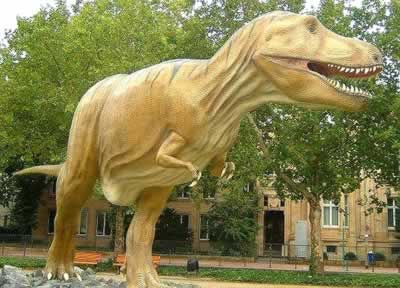
Tyrannosaurus rex was one of the largest land carnivores of all time, measuring up to 43.3 feet long, and 16.6 ft tall, with an estimated mass that goes up to 7 tons. Like other tyrannosaurids, Tyrannosaurus was a bipedal carnivore with a massive skull balanced by a long, heavy tail. Relative to the large and powerful hindlimbs, Tyrannosaurus forelimbs were small and they retained only two digits.
Fossils of T. rex have been found in North American rock formations dating to the last three million years of the Cretaceous Period at the end of the Maastrichtian stage, approximately 68.5 to 65.5 million years ago; it was among the last dinosaurs to exist prior to the Cretaceous-Tertiary extinction event. More than 30 specimens of T. rex have been identified, some of which are nearly complete skeletons. Some researchers have discovered soft tissue as well. The abundance of fossil material has allowed significant research into many aspects of its biology, including life history and biomechanics.

The quagga was originally classified as an individual species, Equus quagga, in 1788. Over the next fifty years or so, many other zebras were described by naturalists and explorers. Because of the great variation in coat patterns (no two zebras are alike), taxonomists were left with a great number of described “species”, and no easy way to tell which of these were true species, which were subspecies, and which were simply natural variants. Long before this confusion was sorted out, the quagga had been hunted to extinction for meat, hides, and to preserve feed for domesticated stock. The last wild quagga was probably shot in the late 1870s, and the last specimen in captivity died on August 12, 1883 at the Artis Magistra zoo in Amsterdam.
Because of the great confusion between different zebra species, particularly among the general public, the quagga had become extinct before it was realized that it appeared to be a separate species. The quagga was the first extinct creature to have its DNA studied. Recent genetic research at the Smithsonian Institution has demonstrated that the quagga was in fact not a separate species at all, but diverged from the extremely variable plains zebra.
 The Thylacine was the largest known carnivorous marsupial of modern times. Native to Australia and New Guinea, it is thought to have become extinct in the 20th century. It is commonly known as the Tasmanian Tiger (due to its striped back), and also known as the Tasmanian Wolf, and colloquially the Tassie (or Tazzy) Tiger or simply the Tiger. It was the last extant member of its genus, Thylacinus, although a number of related species have been found in the fossil record dating back to the early Miocene.
The Thylacine became extinct on the Australian mainland thousands of years before European settlement of the continent, but survived on the island of Tasmania along with a number of other endemic species such as the Tasmanian Devil. Intensive hunting encouraged by bounties is generally blamed for its extinction, but other contributory factors may have been disease, the introduction of dogs, and human encroachment into its habitat. Despite being officially classified as extinct, sightings are still reported.
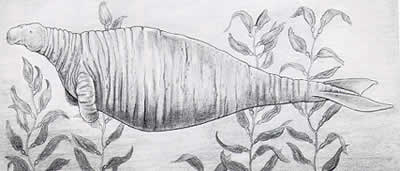

Discussion of the cause of their extinction has still focused on the antlers (rather than on their overall body size), which may be due more to their impact on the observer than any actual property. Some have suggested hunting by man was a contributing factor in the demise of the Irish Elk as it was with many prehistoric megafauna, even assuming that the large antler size restricted the movement of males through forested regions or that it was by some other means a “maladaptation”. But evidence for overhunting is equivocal, and as a continental species, it would have co-evolved with humans throughout its existence and presumably have adapted to their presence.

The body of this subspecies was quite stocky and elongated with strong legs, big wide paws and unusually large claws. The ears were short and small, and gave the appearance of being without hair on the tips. Around the cheeks the Caspian tiger was generously furred and the rest of its fur was long and thick. The colouration resembled that of the Bengal tiger. Male Caspian tigers were very large and weighed 169-240 kg. Females were not as large, weighing 85-135 kg. There are still occasional claims of the Caspian tiger being sighted.
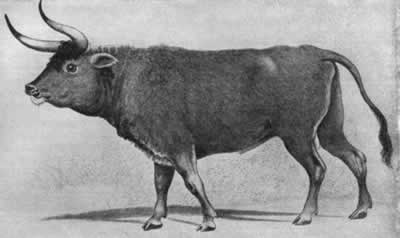
By the 13th century A.D., the aurochs’ range was restricted to Poland, Lithuania, Moldavia, Transylvania and East Prussia. The right to hunt large animals on any land was restricted to nobles and gradually to the royal household. As the population of aurochs declined, hunting ceased but the royal court still required gamekeepers to provide open fields for the aurochs to graze in. The gamekeepers were exempted from local taxes in exchange for their service and a decree made poaching an aurochs punishable by death. In 1564, the gamekeepers knew of only 38 animals, according to the royal survey. The last recorded live aurochs, a female, died in 1627 in the Jaktorów Forest, Poland. The skull was later taken by the Swedish Army and is now the property of Livrustkammaren in Stockholm.
In the 1920s two German zookeepers, the brothers Heinz and Lutz Heck, attempted to breed the aurochs back into existence (see breeding back) from the domestic cattle that were their descendants. Their plan was based on the conception that a species is not extinct as long as all its genes are still present in a living population. The result is the breed called Heck Cattle, ‘Recreated Aurochs’, or ‘Heck Aurochs’, which bears an incomplete resemblance to what is known about the physiology of the wild aurochs
 The Great Auk was the only species in the genus Pinguinus, flightless giant auks from the Atlantic, to survive until recent times, but is extinct today. It was also known as garefowl, or penguin.
Standing about 75 centimetres or 30-34 inches high and weighing around 5 kg, the flightless Great Auk was the largest of the auks. It had white and glossy black feathers. In the past, the Great Auk was found in great numbers on islands off eastern Canada, Greenland, Iceland, Norway, Ireland and Great Britain, but it was eventually hunted to extinction. Remains found in Floridan middens suggest that at least occasionally, birds ventured that far south in winter as recently as in the 14th century.
 The Dodo (Raphus cucullatus) was a flightless bird that lived on the island of Mauritius. Related to pigeons and doves, it stood about a meter tall (three feet), lived on fruit and nested on the ground. The dodo has been extinct since the mid-to-late 17th century. It is commonly used as the archetype of an extinct species because its extinction occurred during recorded human history, and was directly attributable to human activity. The adjective phrase “as dead as a dodo” means undoubtedly and unquestionably dead. The verb phrase “to go the way of the dodo” means to become extinct or obsolete, to fall out of common usage or practice, or to become a thing of the past.
More Info:  Did you know that 99.9% of all species that have ever existed on Earth are now extinct? Ross Piper’s book Extinct Animals: An Encyclopedia of Species that Have Disappeared during Human History highlights 65 creatures that are presumed extinct. Grouping his two- to four-page entries into chronological chapters, the author goes backward in time, beginning with the golden toad, the Eskimo curlew, and five others that were last seen less than 100 years ago, and ending more than 50,000 years ago with the likes of the megatooth shark and the giant ape. Homo erectus and its near relatives are included, too.